 By Michael Owen
Backpacking and crisp clothing have long seemed mutually exclusive. The standard image of a backpacker involves rumpled linen, creased collars, and garments stuffed haphazardly into the dark recesses of a nylon sack. Yet whether you are traveling for business with a minimalist carry-on, attending a destination wedding, or simply preferring to look put together when you arrive, living out of a backpack does not require you to surrender your standards.
Creases are not an inevitable tax on mobile travel. They are the predictable byproduct of physics—specifically, the interplay of friction, pressure, moisture, and time. When you understand how these forces interact with different textiles, packing shifts from a gamble into a calculated system. With the right fabric choices, deliberate folding architectures, and strategic load distribution, you can pull a collared shirt or tailored pair of trousers out of a 35-liter pack and wear it immediately.
The Physics of Fabric Creasing
To solve the problem of wrinkled clothing, you have to look at what happens at the fiber level. Natural fibers such as cotton, linen, and rayon are composed of cellulose chains bound by weak hydrogen bonds. When garments are subjected to ambient warmth and moisture—whether from humidity, body heat, or residual warmth from recent laundering—those hydrogen bonds break and loosen.
When external pressure is applied, as happens when clothes are wedged inside a tight pack, the relaxed fibers are forced into new, bent angles. As the fabric cools or dries while pinned under that weight, the hydrogen bonds reform in those distorted positions. The result is a set crease. Synthetic fibers behave similarly under mechanical stress, though their molecular structures possess greater inherent elasticity.
Preventing wrinkles therefore requires eliminating at least two of three variables: heat/moisture, friction between fabrics, and uneven directional pressure. If you can keep the fabric dry, isolate it from friction, and distribute pressure evenly rather than along sharp folds, wrinkles simply cannot form.
Fabric Selection: Your First Line of Defense
No packing technique can salvage a tightly woven, thin cotton poplin shirt packed at the bottom of a rucksack for three days. Your packing strategy begins in your closet long before you open your bag.
Natural Resilient Fibers
Merino wool stands out as the single most crease-resistant natural textile for travelers. The natural crimp of wool fibers gives them exceptional structural memory; they can bend thousands of times without breaking and spring back into their original shape when released from pressure. Lightweight merino t-shirts, button-downs, and knit sweaters resist creasing almost entirely while remaining breathable and odor-resistant.
High-Performance Synthetics and Blends
Technical fabrics engineered with nylon, polyester, and elastane (spandex) offer built-in resistance to creasing. Look for fabrics with mechanical stretch or open-knit weaves rather than dense, rigid plain weaves. Synthetic blends formulated for travel dry rapidly, wick moisture, and rebound quickly from being packed tightly.
Problematic Weaves to Handle with Care
Linen, cotton seersucker, and lightweight cotton weaves demand the most attention. If you must carry linen, embrace heavy-weight linen over sheer varieties, or opt for linen-cotton or linen-tencel blends. Tencel (lyocell) drapes fluidly and handles compression significantly better than traditional viscose or standard cotton.
Packing Techniques That Eliminate Hard Folds
The traditional flat-square fold taught in retail stores is the primary cause of travel wrinkles. Every right-angle fold creates a localized point of intense pressure where outer fibers stretch and inner fibers compress. To keep your garments smooth, you must replace sharp angles with sweeping curves or continuous tension.
The Bundle Wrapping Method
For delicate garments, dress shirts, blazers, and tailored pants, bundle wrapping is the most effective technique available. Instead of folding each item individually, you wrap your garments sequentially around a central core, such as a toiletry kit or a soft cube filled with underwear and socks.
To build a bundle, start by laying your most structured and wrinkle-prone piece—typically a jacket or collared shirt—flat on a bed, buttoned up, with the front facing down. Lay the next garment across it in the opposite direction. Continue layering garments, rotating orientations, with the least wrinkle-sensitive items near the center.
Place your core object in the middle, then fold the sleeves and tails of each garment smoothly over the core, working from the inside layer out. Because every piece wraps smoothly around the curve of the layer beneath it, there are no hard edges, zero sharp pinch points, and virtually no internal friction. When you unwrap the bundle at your destination, each item emerges smooth and relaxed.
The Tensioned Cylinder (Ranger Roll)
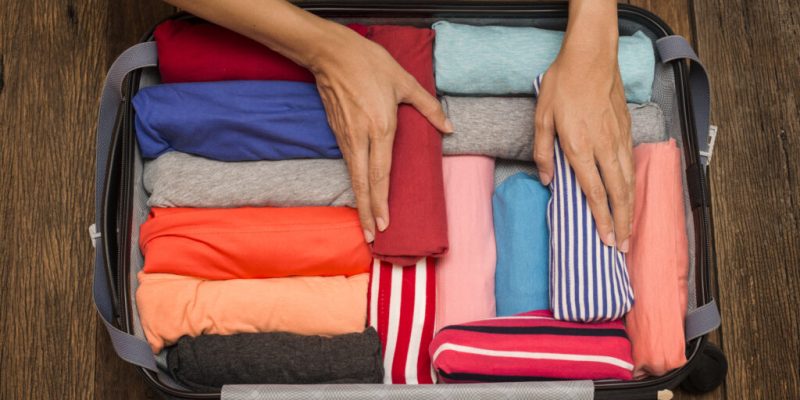
Rolling clothes is widely recommended, but improper rolling actually introduces spiral creases and uneven bunching. A standard loose roll crumbles under the weight of other gear. A proper tension roll, adapted from military packing methods, creates a firm, stable cylinder that keeps fabric taut without overstretching it.
To execute this properly on casual button-downs, knits, and t-shirts:
-
Lay the garment completely flat, smoothing out every bubble and wrinkle with your palms.
-
Invert a small cuff (about two inches) at the bottom hem of the garment.
-
Fold the sides inward so the garment forms a clean, uniform rectangle matching the width you want for the roll.
-
Beginning at the collar or top hem, roll downward with steady, even pressure, keeping the tension consistent across the entire width.
-
Once you reach the bottom, fold the inverted cuff over the cylinder to lock it in place.
The outer lock holds the roll secure, preventing the fabric from uncoiling and shifting inside the pack during transit.
The Low-Friction Plastic Barrier
One of the most overlooked secrets of wrinkle prevention is reducing surface friction between garments. When two cotton shirts rub against each other during motion, the fibers catch, pull, and drag, creating micro-creases.
Placing a thin layer of plastic—such as dry-cleaning bags or lightweight poly bags—between the folds of your dress shirts completely eliminates this friction. The slippery plastic allows the fabric layers to slide past one another instead of catching when the pack flexes or settles. If you fold a dress shirt around a single dry-cleaning bag, it will arrive significantly cleaner and crisper than the same shirt folded against itself.
Gear Architecture: Organizing the Backpack Interior
How you arrange the interior of your backpack matters just as much as how you fold your garments. Backpacks are dynamic containers: as you walk, run for a train, or lean over, the load shifts, generating compression waves throughout the pack.
Garment Folders Over High-Compression Cubes
Compression packing cubes are exceptional for maximizing space when packing socks, base layers, and bulky fleece, but they are hostile to formal clothing. Squeezing garments with compression zippers or purge valves forces wrinkles deeply into woven fabrics.
Instead, invest in an envelope-style structured garment folder. These rigid organizers feature a folding board that guides uniform folding, paired with stiff Velcro wings that secure the garments under light, consistent surface pressure. The rigid backing prevents the shirts from bending or buckling when the pack flexes against your spine.
Zoned Loading Strategy
Think of your backpack as three distinct pressure zones:
-
The High-Pressure Base: The bottom of the bag bears the entire weight of the gear above it. Reserve this section for heavy, dense, and non-wrinkling items: trail shoes, chargers, extra shoes in shoe bags, or dense compression cubes holding workout gear.
-
The Spinal Core: The area directly against your back panel should hold your heaviest gear (such as a laptop, camera gear, or heavy dopp kit) to keep the center of gravity close to your body.
-
The Low-Stress Upper Third: The top third of the pack, as well as the outer front panel away from the compression straps, receives the least direct crushing force. This is where your garment folder, bundle wrap, or fine-knit rolls belong.
Never tighten your backpack’s external compression straps directly across the zone where your dress shirts or trousers are packed. Cinching those straps creates uneven localized pinch lines that are exceptionally difficult to remove without a heavy iron.
Quick Field Recovery for Inevitable Creases
Even with flawless preparation, extended transit through varying climates can occasionally leave minor surface waves on your clothes. When you unpack, a few practical recovery tactics can restore a sharp drape without an ironing board.
Immediately unpack your clothes the moment you reach your accommodation. Shaking out a garment and hanging it allows the fibers to relax while they still retain residual warmth from the bag. Hang garments on broad-shouldered wooden or contoured plastic hangers rather than thin wire alternatives that distort the shoulder seams.
The classic shower steam method works remarkably well if executed properly. Hang the garment on the back of the bathroom door or on the shower rod—well away from water splashes—while taking a hot shower. The ambient humidity breaks the temporary bonds in the creases.
Crucially, do not wear or pack the garment while it is still warm and damp. Once the steam has relaxed the fibers, move the hanger into the main room where there is good airflow, gently smooth the seams and placket downward with clean hands, and let it hang undisturbed for fifteen minutes. This cooling phase sets the hydrogen bonds back into their smooth, straight configuration.
For targeted problem spots like collars, cuffs, or hemlines, a damp washcloth smoothed firmly over the crease, followed by brief drying with a standard hotel hair dryer held six inches away, will flatten stubborn lines in under two minutes.
Mastering wrinkle-free packing is not about packing more gear; it is about respecting the physical properties of the clothes you carry. By selecting resilient textiles, using tension and friction barriers instead of hard folds, and isolating delicate pieces from heavy pack weight, you ensure that traveling light never means looking unkempt.
What is your reaction?
Excited
0
Happy
0
In Love
0
Not Sure
0
Silly
0