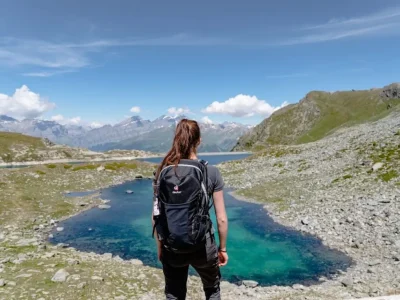
Hiking

Footprints Through Wild Places: The Timeless Joy and Subtle Wisdom of Hiking

Introduction

Among life’s simplest pleasures, few rival the enduring charm of hiking. It is an act so deceptively humble—walking through wild places, tracing trails across forests, mountains, or moorlands—yet it offers a depth of satisfaction that feels increasingly rare in an age of instant comforts and constant connectivity. To hike is to pause the noise of modern life and step, quite literally, into the world at its purest. It is the art of moving slowly enough to truly see, feel, and belong.

Why We Hike

Hiking is more than a pastime or exercise routine; it is an instinct woven into human history. Long before roads or railways, humans journeyed on foot—tracking game, migrating with the seasons, exploring the unknown. That primal memory still stirs within us each time we lace our boots and set off towards a horizon.

People today hike for countless reasons. Some crave physical challenge, pushing their bodies up steep inclines and along ridgelines where the wind is sharp and the vistas infinite. Others seek solace, a quiet reprieve from screens, schedules, and the press of crowds. For many, it is the mindful act of placing one foot in front of the other that brings the greatest clarity, easing tangled thoughts with each mile.

A Journey for All Seasons

Unlike more technical outdoor pursuits, hiking invites nearly everyone. Its simplicity is part of its magic. There is a trail for every ambition, whether a gentle woodland loop in early spring, a sunlit ascent to an alpine meadow in midsummer, a forest ablaze with autumn gold, or a bracing winter ramble across frost-tipped hills.

Every season brings its own wonders:

  • Spring: Budding wildflowers, soft trails damp from snowmelt, birds returning from distant migrations.

  • Summer: Long daylight hours, clear skies, the hum of insects and the rustle of wind through green canopies.

  • Autumn: Crisp air, vibrant foliage, the crunch of dry leaves beneath sturdy boots.

  • Winter: Quiet paths, frost-laced branches, the solitude of snow-dusted trails.

Such variety keeps even familiar routes fresh, a reminder that nature’s beauty is never static.

Mind, Body, and Soul

Hiking rewards us in ways few activities can. On a physical level, it strengthens muscles, joints, and lungs without requiring the punishing impacts of running or the complex equipment of cycling or climbing. The constant adjustments of balance over uneven ground build coordination and resilience in subtle ways.

But its real power lies deeper. Countless studies show that time spent in nature calms the mind. Cortisol levels drop. Heart rates settle. Thoughts untangle. Many who hike alone speak of the trail as a confessional, a place where problems are laid bare and often solved by the simple rhythm of walking under an open sky.

The Many Faces of the Trail

A single word—hiking—hides countless forms. Its beauty is that it bends to your mood, skill, and spirit of adventure.

Day Hikes

  • Short, manageable routes perfect for a few hours of fresh air.

  • Often well-marked and accessible from cities or towns.

  • Ideal for families, casual walkers, and beginners.

Long-Distance Treks

  • Multi-day journeys through remote landscapes.

  • Demand preparation, stamina, and often, wilderness camping.

  • Legendary examples include the Appalachian Trail, the Pacific Crest Trail, or Europe’s Tour du Mont Blanc.

Pilgrimage Trails

  • Routes steeped in history and spirituality.

  • Paths like Spain’s Camino de Santiago or Japan’s Kumano Kodo draw modern pilgrims in search of meaning and reflection.

Urban Hiking

  • A modern twist for city dwellers.

  • Exploring local parks, hidden stairways, and overlooked green spaces.

  • Reminds us that adventure can hide in plain sight.

Essentials for the Trail

Part of hiking’s quiet joy is how little it truly requires. Still, a few thoughtful essentials can turn a good hike into a great one.

  • Footwear: Well-fitting boots or trail shoes prevent blisters and offer crucial support.

  • Layers: Weather shifts quickly; dress to adjust easily to changing temperatures.

  • Navigation: A paper map and compass, or an offline-capable GPS app.

  • Water: The most vital item of all—carry more than you think you’ll need.

  • Food: Simple, high-energy snacks to keep you fuelled.

  • Sun Protection: A hat, sunglasses, and sunscreen.

  • Emergency Basics: A small first-aid kit, flashlight, and whistle.

For longer treks, consider a sturdy backpack, lightweight shelter, sleeping bag, and cooking gear. A little planning goes a long way towards safety and comfort.

Treading Lightly

The privilege of exploring wild places comes with a responsibility to protect them. Leave No Trace principles guide hikers to minimize their impact:

  • Stay on marked paths to prevent erosion.

  • Pack out every scrap of waste.

  • Respect wildlife by observing from a distance.

  • Keep noise low to let nature’s sounds speak.

  • Yield to uphill hikers and share trails with kindness.

Such simple courtesies ensure that the paths we love remain unspoiled for those who follow.

A Trail of Stories

Beyond fitness and scenery, hiking binds people to places and to each other. Friendships form on trailside benches and mountain huts. Stories are swapped at dusk around a campfire or whispered in early dawn as a new trail unfolds. Even solo hikers often return with tales—of a sudden thunderstorm, a shy deer glimpsed at dusk, a stranger’s kindness miles from anywhere.

These memories weave into a tapestry of shared experience that outlasts any single journey.

Hiking as a Quiet Revolution

Perhaps hiking’s greatest gift is that it reminds us we do not need more to feel more alive. A simple walk through trees or up a sunlit ridge can shift our perspective more profoundly than any digital escape. It is a quiet revolution against speed, screens, and superficial connection.

For families, a day hike might be the rare chance to watch children play freely, their laughter echoing through woods rather than bouncing off walls. For busy professionals, it is a reminder that productivity can wait—nature’s clock runs on older, wiser rhythms.

Conclusion

At its core, hiking is an invitation—one that asks so little yet gives so much. It urges us to trade the paved path for a winding trail, the car’s hum for birdsong, and constant chatter for the simple, steady cadence of our own footsteps.

So tie your laces, shoulder your pack, and find a trail, however near or far. Whether you climb high peaks or wander a nearby glen, may you find in each step the same timeless lesson: that the best journeys need no engines, only an open heart and a willing pair of feet.

What is your reaction?

Excited
0
Happy
0
In Love
0
Not Sure
0
Silly
0

You may also like

Comments are closed.

More in:Hiking